Hello,
Most organizations still rent advisory-grade knowledge by the day: a framework arrives with an engagement, leaves when it ends, and has to be bought again the next time the question comes up.
- The method stays with the consulting firm. Frameworks are reused inside the consulting firm, not by the client. [1]
- Reliance erodes capability. An Australian Senate inquiry found heavy use of consultants “has limited the capability growth” of the public service. [5]
- It costs more. The UK National Audit Office found specialist consultants can cost twice their permanent counterparts. [4]
- AI removes the last reason to keep it outside. The organization that executes the strategy should hold the knowledge, and now it can.
Now released Stratenity announces the release of the Stratenity Library, integrated with the Stratenity Foundation Model.
|
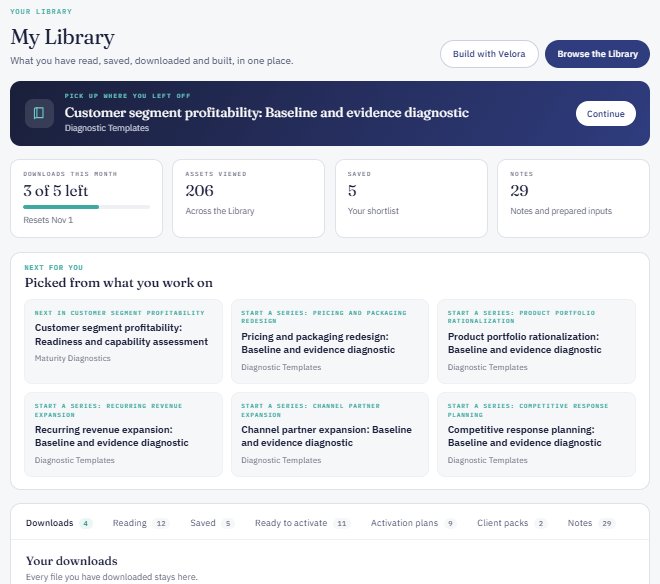
My Library: pick up where you left off, and the next assets picked from what you work on.
| Knowledge creates advantage when it stays with the people who execute. Access to it should be a membership, not an engagement. |
The evidence behind a different approach The cost of renting knowledge is measurable. So is the gain from keeping it.
Figures shown for context from the cited studies and audits. They inform Stratenity’s approach; they are not Stratenity Library performance results. |
How knowledge became a gate
I have spent much of my career on both sides of the engagement. The pattern is familiar: a team brings in outside expertise for a decision that matters, the work is good, and within months the organization is asking the same kind of question again, without the people, the method, or the context that answered it the first time.
Knowledge held as inventory.
- Consulting firms codify and protect knowledge, because reuse earns the margin. [1]
- The client receives the conclusion; the method stays with the consulting firm.
- The learning accumulates in the consulting firm, not in the client. [7]
The engagement ends; the capability leaves.
- Knowledge transfer from consultants does not happen by default. [3]
- When the conditions are missing, the knowledge walks out with the team.
- Australia’s consulting spend tripled every decade for 30 years, limiting public capability. [5]
The next question costs the same.
- Without the method in-house, the organization pays again, often at a premium.
- People spend close to a fifth of their week searching for knowledge already paid for. [2]
| Organizations do not lack access to good thinking. They lack the right to keep it, reuse it, and build on it once the invoice is paid. That is a structural cost, not a pricing detail. |
A different approach: access, not engagements
The Stratenity Library turns advisory-grade knowledge into something your team holds: not borrowed from a consulting firm, and not guessed by a general-purpose chat tool.
| The gated model | General AI chat | The Stratenity Library | |
|---|---|---|---|
| Access | Per engagement, priced by the day | Instant, for anyone | A membership for your team, every day |
| Who holds the method | The consulting firm | No one: answers are generated, not owned | Your people, in full: most assets run 13 sections, with a worked example |
| What remains afterwards | A final deck and an invoice | A chat transcript | Methods your team reuses, adapts, and teaches |
| The next question | Another statement of work | Another prompt, and a different answer | Already in the Library, one search away |
| Acquisition | Whatever the engagement team brings, then it leaves | Whatever the model absorbed in training | Practitioner expertise acquired weekly, human-authored, verified and rights-cleared. stratenity.com/library/knowledge-acquisition |
| Governance | Depends on the engagement team | None before the answer appears; confident guesses can read as fact | Four review layers, two human and two agentic, with a person approving every asset and update. stratenity.com/library/governance |
| Who gains from reuse | The consulting firm, across its clients | The tool provider | Your organization, every time it is used |
| AI | Used inside the consulting firm, on its terms | General-purpose, not grounded in a reviewed method | In your team’s hands: Velora drafts from the asset, with your context |
The research on AI points the same way: the gains go to the people who hold the method, so the organization that keeps the knowledge and gives its people AI captures them.
Inside the Stratenity Library
The Library follows the work itself: ground the case in Evidence, shape the answer in Design, and deliver it in Execution.
■ Evidence 408 Research, diagnostics, maturity models and sector packs |
■ Design 505 Strategy, operating model and AI frameworks, executive templates |
■ Execution 544 Playbooks, workflows, workshops and engagement examples |
Find it: every asset, one search.
Search by question, topic, or code, or simply say what you need. Filter by collection, category, type, and industry. Guided Playbooks and Pathways (Diagnose → Design → 90-Day Execution, Maturity → Roadmap → Governance) show where to start and what comes next.
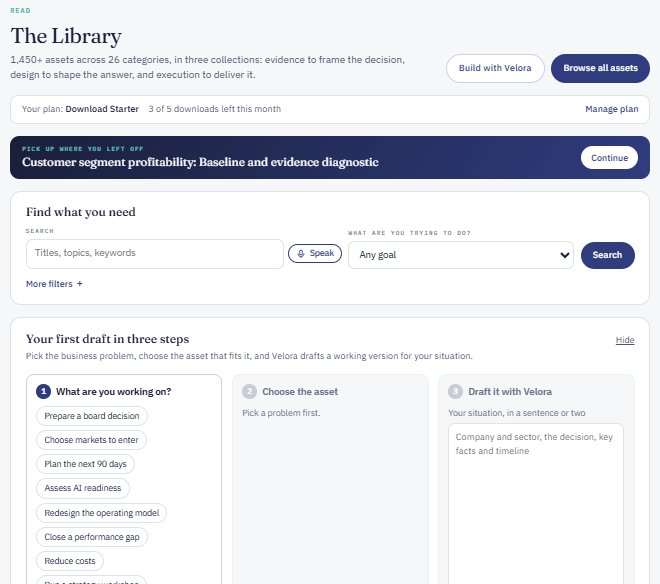
The Library: one search across 1,610+ assets, and a first draft with Velora in three steps.
Read it: the full method, not the summary.
Most assets run 13 sections deep, with appendices, tables, and a completed worked example. Read in focus mode, follow the contents, Summarize or get a two-minute Brief me, Listen on the move, and keep private Notes as you go, typed or dictated.
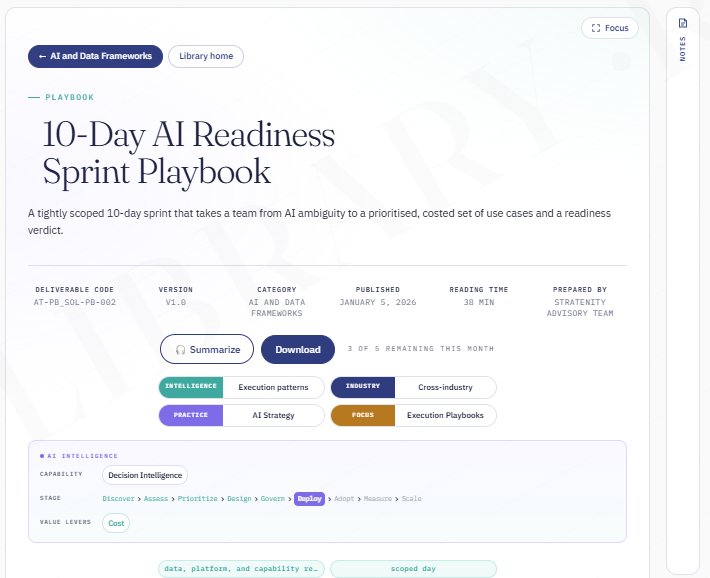
An asset: the method in full, Summarize and Download, and your notes alongside.
Use it: from reading to delivery.
Every asset carries its next steps. Build with Velora drafts a client-ready deliverable from the asset and your situation. The client workflow walks you through Intake, Readiness, Industry Review, and Stakeholder Discovery. An Activation Plan turns the asset into workstreams, milestones, KPIs, and risks, ready to run in the VelorStrategy workspace, and Socialize in Collasia takes the discussion to your community.
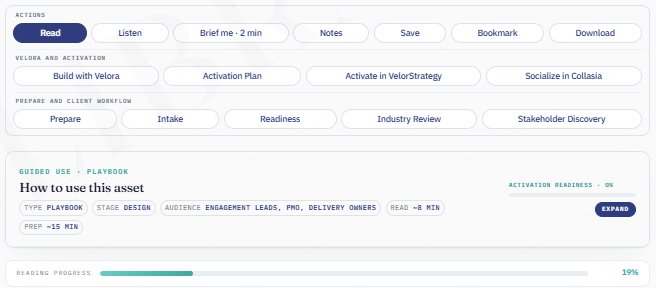
On every asset: read, listen, build, activate, socialize, and prepare the client workflow.
Velora · the Library’s AI Grounded in the Library. Fitted to your organization.Velora works from the asset in front of you and the context you choose to give it. On My Organization, your team records its overview, strategic direction, the decisions the work should support, and its current state. Once you review that context, Build with Velora and the client workflow draw on it, and Next for you suggests what to read next from what you are working on.
Your organization context and notes stay in your account. Drafts that use them are routed through governed foundation-model tools that do not train on your data, and they are kept separate from the public Foundation Model. Every plan includes 50 Velora requests a month. |
The Stratenity Foundation Model, now integrated
Start before you sign up. The Stratenity Foundation Model gives anyone an evidence-backed starting point, drawn from the Library’s public pages.
Choose what you want to do, pick a domain and an industry, and describe the challenge. The Foundation Model returns guidance and the Library assets that address it. Save the analysis, and it is waiting in your Library when you join, connected to the assets in full, your notes, and Build with Velora.
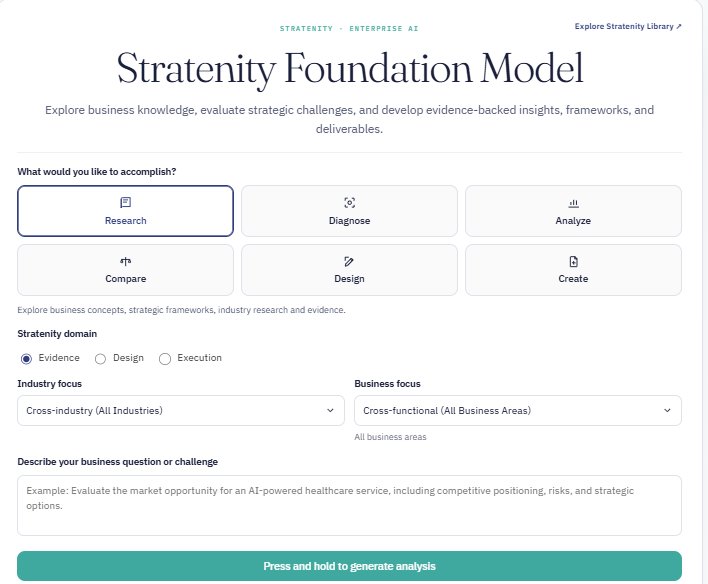
The Stratenity Foundation Model: choose what you want to do, set the domain and focus, and describe the challenge.
| Research Concepts, frameworks, industry research and evidence |
Diagnose Readiness, operating models, capabilities and gaps |
Analyze Markets, industries and business performance |
| Compare Options, competitors, industries and scenarios |
Design Strategies, operating models and target states |
Create Reports, plans, templates and business cases |
It is free to use, with five analyses a week. Stratenity is a member of NVIDIA Inception, and the Foundation Model integrates key NVIDIA technologies across its stack.
Membership, not engagements
Every plan includes the full Library in the browser, Velora, and Collasia membership. One account signs your team in to every Stratenity product and the VelorStrategy workspace.
Read $49 / month 50 assets and 50 Velora requests a month, plus Collasia membership |
Download Starter $98 / month Everything in Read, 5 downloads a month, Build with Velora and Activation Plans |
Download Pro $147 / month Everything in Starter, 10 downloads a month, early access and quarterly sector deep packs |
Save 8% with annual billing. Cancel anytime. Compare plans and pricing →
For firms and practices Need more than the Pro plan, a private library for your team, or a dedicated Library space built and maintained for your practice? Talk to the Advisory team → |
Plain English
Good strategy knowledge has always existed. The question is who gets to keep it. In the gated model, the consulting firm keeps the method, the client keeps the invoice, and the next question starts the meter again. With AI now accelerating the work itself, that trade has never been harder to justify.
The Stratenity Library is built for the opposite: your team holds the methods, uses them every day, and builds on them with Velora, so the capability compounds inside your organization instead of leaving with the engagement. The question we hold ourselves to is simple: did this help your people decide better, deliver faster, and need us less for the same question next time?
The Stratenity Library is here Stop renting knowledge. |
I invite you to bring a real decision to the Library: a market you are weighing, an operating model that needs to change, a plan that has to land in the next 90 days. Start with the Foundation Model, then put your team to work on it.
Sincerely,
Dodi
Dr. Dodi Mossafer, DBA
Founder
Stratenity - member of NVIDIA Inception
advisory@velorstrategy.com · stratenity.com · LinkedIn → · Book time with me →
Across Stratenity The Library connects to the rest of the portfolio: VelorStrategy gives the work a workspace and desks to run in, Collasia brings the people and the discussion, and the public Stratenity Resources keep open knowledge within reach. Collasia membership is included in every Library plan. |
- Hansen, M. T., Nohria, N., & Tierney, T. (1999). What’s your strategy for managing knowledge? Harvard Business Review, 77(2), 106–116. hbr.org record · HBS Working Knowledge summary.
- McKinsey Global Institute (2012). The social economy: Unlocking value and productivity through social technologies. Report page.
- Ko, D.-G., Kirsch, L. J., & King, W. R. (2005). Antecedents of knowledge transfer from consultants to clients in enterprise system implementations. MIS Quarterly, 29(1), 59–85. AIS eLibrary record.
- National Audit Office (2016). Use of consultants and temporary staff. Report by the Comptroller and Auditor General. nao.org.uk.
- Senate Finance and Public Administration References Committee, Parliament of Australia (2024). Management and assurance of integrity by consulting services provided for the Australian Government. Final report, June 2024. aph.gov.au · AAP coverage.
- Brynjolfsson, E., Li, D., & Raymond, L. (2025). Generative AI at work. The Quarterly Journal of Economics, 140(2), 889–942. doi:10.1093/qje/qjae044. Earlier version: NBER Working Paper 31161.
- Mazzucato, M., & Collington, R. (2023). The big con: How the consulting industry weakens our businesses, infantilizes our governments, and warps our economies. Penguin Press.