Dear colleague,
Scroll. Post. React. Repeat. Professional networking has become another demand on your attention: another feed to monitor, another profile to maintain, another message to sort before you find a conversation worth having.
When staying visible requires constant self-promotion, the platform starts to feel like a second job. You can grow a network and still struggle to find useful help. You can spend an evening reacting to other people’s achievements and leave without advancing a single relationship of your own.
That is the model we challenge: networking that asks for continuous activity while leaving the hardest work (finding relevance, establishing trust, and following through) to you.
Stratenity announces the release of Collasia, a community centered on people, knowledge, contributions, gatherings, and support. We built it from a simple conviction: in the era of AI, genuine human relationships matter more than ever. The traditional networking model no longer works; loaded with automation, it has become machine-to-human interaction beyond human capacity. The next shift in enterprise AI will come through human relationships, and we intend to lead it, centered on human judgment and governance. |
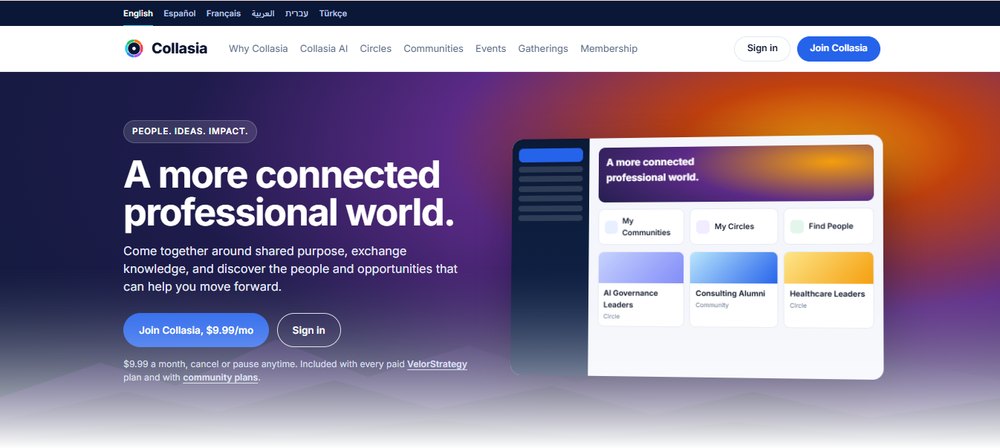
collasia.com: a more connected professional world.
| The acceleration of enterprise AI will not happen at the model or technical level alone. It will happen at the human-to-human level, where genuine relationships, judgment, and trust turn intelligence into results. |
With Collasia AI, our philosophy is to put intelligence in service of useful participation and human relationships, measured by one standard: does your time here help you move forward? This is Stratenity’s enterprise AI philosophy, that work, intelligence, and human relationships belong in the same execution system.
Stratenity Stratenity is an integrated enterprise AI company building the AI operating system for strategic execution. Our commitment is responsible, human-centered, AI-powered enterprise acceleration: helping people and organizations bring intelligence into meaningful work while strengthening the relationships that make that work possible. Collasia is part of that commitment. |
The evidence behind a more human approach Social fatigue is a documented problem.
Study sizes shown for context. Research findings inform Collasia’s philosophy; they are not Collasia performance results. |
The research describes the fatigue; Collasia is our answer to it. Instead of another feed asking for more activity, members land in a space built around purposeful participation. Here is what that looks like inside: communities, Circles, and a first week designed to bring the right people closer.
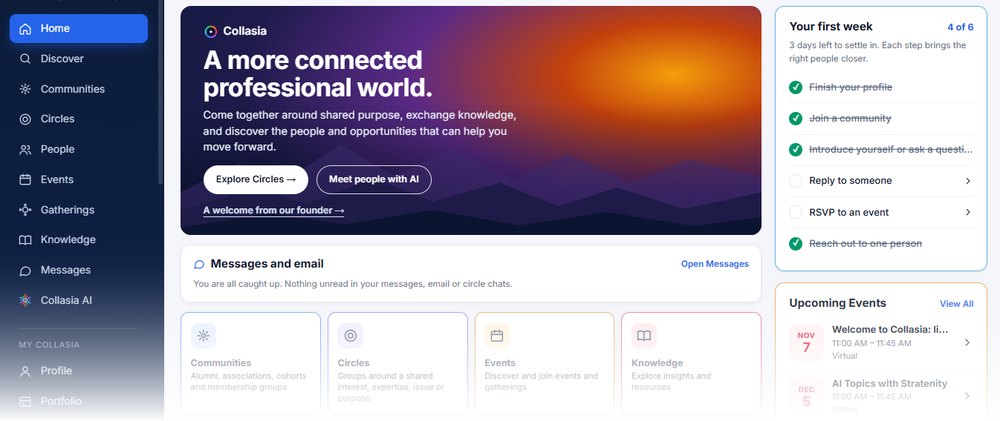
Inside Collasia: communities, circles, and your first week.
The problem worth solving
We built Collasia around purposeful professional relationships instead of a performance for a feed. My starting point for Collasia is a simpler question: when we say we are connected, what can we actually do for one another?
A profile can tell me where someone worked. A relationship can tell me how they think, what they care about, and whether we can rely on one another. Professional life needs both discovery and depth. Collasia connects discovery with meaningful participation.
Collasia gives people Circles and communities for serious questions, useful knowledge, and practical help. Collasia AI summarizes discussions and surfaces relevant expertise. Members participate around a shared purpose, with room for their own voice.
| A connection count tells us how many people are linked. It does not tell us what they can accomplish together. |
The fatigue behind the feed
The problem begins when the work of being seen crowds out the work of connecting.
The visibility treadmill.
Post often. React quickly. Keep the profile active. When participation becomes a performance of success, quieter expertise and honest questions have to compete with whatever attracts attention. Collasia makes room for contribution through discussions, knowledge, Circles, and gatherings.
The overloaded feed.
Advice, announcements, promotions, invitations, and updates arrive together. You do the sorting. A meta-analysis of 64 studies involving 28,357 participants found that information overload, social overload, feature overload, and anxiety were among the factors most strongly associated with social media fatigue. Fatigue was also associated with discontinuing use. [4]
AI automation is making the authenticity problem harder.
AI can now produce the post, write the pitch, and generate the reply. The recipient still has to decide whether a real person is interested, whether the claim is credible, and whether the exchange deserves their time. Faster production does not remove that burden; it can multiply it.
This concern is visible inside the incumbent platform itself. LinkedIn’s product leadership has described member feedback tools for content that feels inauthentic or heavily AI-generated, and a shift from enhancing posts to proofreading without changing the author’s voice. [5]
Our position is direct: automate the preparation and organizational burden of participation; preserve the human intention behind the relationship. Collasia AI finds relevance, summarizes discussions, and identifies expertise. It connects people without writing their contributions for them. |
The unfinished relationship.
Discovery matters: LinkedIn experiments involving more than 20 million people showed that weak ties can support job mobility, with effects varying by industry and tie measure. But a recommendation cannot do the human work of establishing trust or carrying a commitment forward. Collasia connects discovery to Circles, conversations, gatherings, and work. [1]
For associations, alumni communities, founders, and industry groups, the strategic question is whether the community makes members more capable of helping one another. Audience size is only part of that answer. |
The philosophy behind Collasia
Collasia begins with six connected ideas. Each gives a relationship somewhere to go after the first introduction.
People: understand the person behind the profile.
Make room for interests, experience, current questions, and the ways someone wants to contribute. Profiles, interests, and contributions provide context beyond a job title.
Relationships: preserve context and follow-through.
Help people carry forward why they connected, what they discussed, and what they agreed to do. Let members decide which relationships they wish to deepen.
Knowledge: make useful insight easier to revisit.
Organize exchanges so that a good answer or resource can be found again. Sources and context matter when someone intends to act on what they learn.
Contributions: recognize what someone gives.
A thoughtful answer, an introduction, practical help, or time spent hosting can create value. Collasia’s philosophy gives those contributions a place in professional identity. What someone gives matters alongside what they have achieved.
Gatherings: give people a reason to come together.
Dinners, hosted conversations, fundraising, and other purposeful gatherings can give an introduction a shared setting. Members host gatherings, choose who joins, and continue the relationship in Circles and communities.
Support: make it possible to ask.
A community needs a place for a real question, a request for help, and a response from someone able to contribute. Circles give members a place to ask, exchange knowledge, and contribute.
Our enterprise AI philosophy: work and relationships are intertwined.
Stratenity sees enterprise AI as an operating system for strategic execution. That requires more than making an individual task faster. Enterprise work depends on people interpreting evidence together, challenging assumptions, sharing knowledge, agreeing on priorities, and following through.
Human relationships are an operating variable in that work. They change whose knowledge reaches a decision, whether a difficult question gets asked, whether someone seeks help early, and whether a commitment carries meaning beyond a task list. A networking event can create an introduction. The relationship is what continues to influence the work afterward.
Research on knowledge transfer supports part of this distinction: Levin and Cross found that trust in competence and benevolence helped explain the receipt of useful knowledge across three companies. Our enterprise interpretation is that access to expertise becomes more useful when people have a basis for trusting and applying it. [3]
In the era of AI, producing a draft, an analysis, or a recommendation can become easier. People still have to decide what deserves confidence, what fits the situation, and what they are willing to act on together. Stratenity brings AI, workspaces, and human community together through its products and applications.
| Human relationships belong inside enterprise execution. They shape how knowledge becomes judgment, how judgment becomes commitment, and how people carry the work forward. |
These belong together because work has a human context. A desk holds the work. A relationship can change how that work is understood, challenged, and advanced. Collasia and VelorStrategy connect those dimensions.
Collasia AI AI orchestration for a more useful community.This is how Collasia answers the fatigue of the old model. Where endless feeds, performative posting, and automated outreach add noise, Collasia AI reduces it: it finds relevance, summarizes discussions, surfaces people worth meeting, organizes knowledge, identifies expertise, and points you to where your experience can help, all connected to what you are working on. It supports members without posting, pitching, or speaking for them.
Collasia AI supports discovery and understanding. People create the trust, conversation, collaboration, and commitment. The relationship remains between people. |
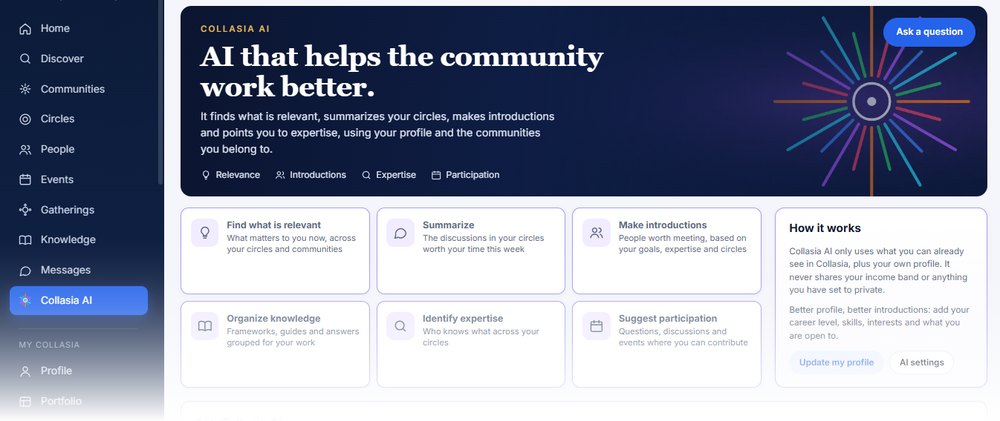
Collasia AI: finds relevance, summarizes, and identifies expertise.
Stratenity Unified Access Built into Stratenity products. Unified access across the portfolio, a continuous path between discussion and work. Collasia brings people and perspective together. VelorStrategy’s workspace and desks give the discussion somewhere to develop. Collasia AI belongs across that experience, with intelligence serving context, relevance, and useful participation. The Stratenity Library is integrated with the workspace too, so reusable frameworks, templates, and guides come straight into the desk where the work happens, and the public Stratenity Resources keep open knowledge within reach. |
Our commitment No ads. No promotions. |
Introducing Collasia. You’re invited.
Collasia is released, and we invite you to join the community at www.collasia.com.
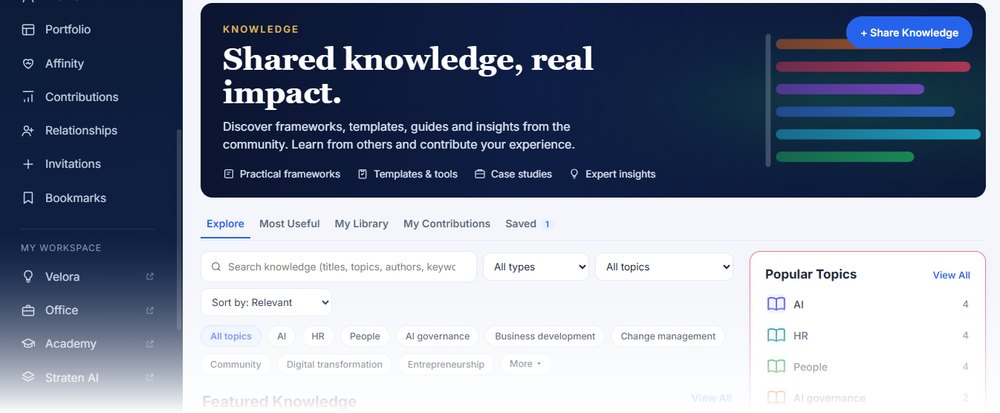
Collasia Knowledge: frameworks, templates, guides, and insights.
Come with something you want to learn, something you can share, or a conversation you want to open. You do not need a large audience to make a meaningful contribution. You need a reason to connect and a willingness to participate.
For professionals
Bring your experience, your questions, and the interests that extend beyond your job title. Help shape a community where people can know you through your thinking and contributions.
For founders and business leaders
Bring a practical challenge, a lesson from building, or a perspective others can use. Give a conversation room to develop before it becomes a transaction.
For community builders, hosts, and industry groups
Bring the people and purposes you care about. Help create reasons to gather, exchange knowledge, and sustain relationships beyond a single event.
| Bring to the community | Give the relationship a purpose |
|---|---|
| A question | Open a conversation around something you genuinely want to understand |
| Experience | Share a lesson someone else can put to work |
| A contribution | Offer knowledge, an introduction, or practical support |
| An invitation | Create a reason for people to come together |
| Curiosity | Learn who someone is beyond the profile |
These are ways to participate in Collasia. Members shape the community through the knowledge they share, the conversations they open, and the help they give.
More ways to take part: explore gatherings and live events, or partner with us to bring Collasia to your team, association, or community.
Plain English
Professional networks have made it easier to find people. A useful community helps people do something meaningful after they find one another.
That is the shift Collasia is built for, and it is where we believe enterprise AI accelerates: at the human-to-human level, not the model alone. The question we hold ourselves to is simple: did this relationship help someone learn, contribute, solve a problem, or take the next step?
Collasia is here · Built by Stratenity Enough of the noise. |
I invite you to join Collasia and bring something of yourself to the community. A question. A lesson. An invitation. A willingness to help. That is where a meaningful relationship begins.
Sincerely,
Dodi
Dodi Mossafer
Founder
Stratenity - member of NVIDIA Inception
advisory@velorstrategy.com · stratenity.com · Read my welcome letter →
Collasia Apps The Collasia apps for iOS and Android have been submitted to the Apple App Store and Google Play and are pending approval. They will be available soon. |
This leadership perspective combines published research with Stratenity’s philosophy for professional community. The research supports the discussion of relationships, communication, and trust; it does not establish Collasia’s performance or guarantee individual outcomes.
The LinkedIn evidence comes from randomized experiments on connection recommendations and concerns job mobility. The Facebook evidence is an opt-in longitudinal panel and concerns well-being associations. The knowledge-transfer evidence is a survey across three companies. The fatigue evidence synthesizes 64 empirical studies and reports associations; it is not a causal audit of LinkedIn or a Collasia outcome study. Collasia membership and the six community roles of Collasia AI reflect the public Collasia website reviewed October 8, 2026. The research does not establish outcomes for Collasia AI. Stratenity’s commitments include no ads or promotions, unified product access, and responsible, human-centered enterprise AI. These findings are specific to their study settings and are not current platform audits.
- Rajkumar, K., Saint-Jacques, G., Bojinov, I., Brynjolfsson, E., & Aral, S. (2022). A causal test of the strength of weak ties. Science, 377(6612), 1304–1310. doi:10.1126/science.abl4476. Abstract and bibliographic record.
- Burke, M., & Kraut, R. E. (2016). The relationship between Facebook use and well-being depends on communication type and tie strength. Journal of Computer-Mediated Communication, 21(4), 265–281. doi:10.1111/jcc4.12162.
- Levin, D. Z., & Cross, R. (2004). The strength of weak ties you can trust: The mediating role of trust in effective knowledge transfer. Management Science, 50(11), 1477–1490. doi:10.1287/mnsc.1030.0136.
- Ou, M., Zheng, H., Kim, H. K., & Chen, X. A meta-analysis of social media fatigue: Drivers and a major consequence. Computers in Human Behavior. doi:10.1016/j.chb.2022.107597.
- Srinivasan, H. (2026). LinkedIn product statement on AI-generated content, authenticity feedback, and preserving author voice. Original LinkedIn statement.
Product context: Collasia · Founder’s letter · Gatherings · Events.
Research and source records checked October 8, 2026. This perspective is provided for informational purposes.